
Key Takeaways
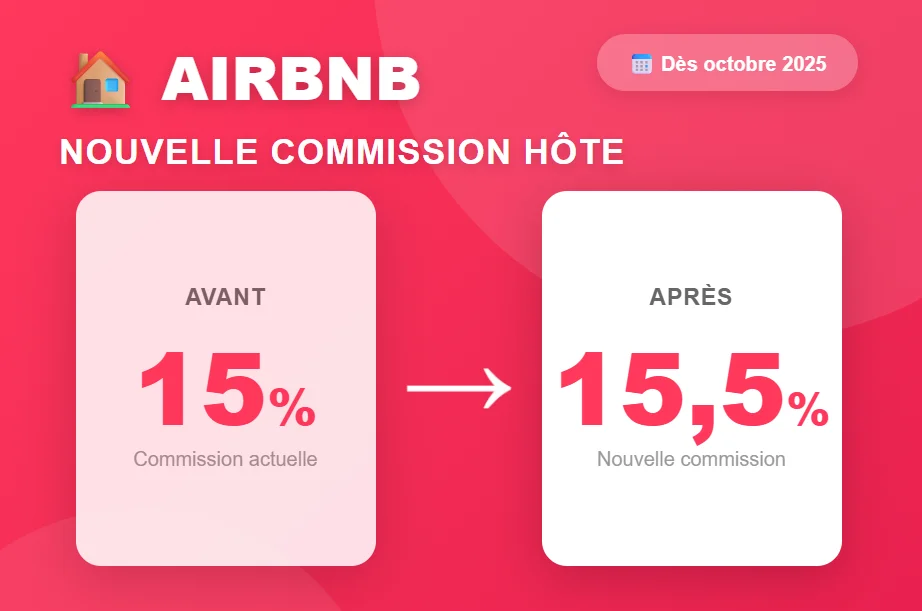
- The Airbnb fee increase raises host commissions from 15% to 15.5% for hosts using property management software, directly impacting rental profitability.
- A smart pricing strategy can offset the Airbnb fee increase without losing competitiveness, by adjusting rates differently across high and low demand periods.
- Fine-tuned rate management remains the key to maintaining stable net revenue while preserving your platform visibility.
The Airbnb fee increase from October 2025 creates a new reality for all short-term rental owners. This 0.5% commission rise (from 15% to 15.5%) may seem minor on the surface, but it directly impacts your profit margin. Faced with this Airbnb fee increase, the best strategy isn’t to raise all your rates uniformly, but to implement an intelligent, differentiated approach.
What Changes with the 2025 Airbnb Fee Increase
Before this update, property owners had a choice between two pricing models:
- Model 1 – Split fees: approximately 3% for the host and 14-16% for the guest
- Model 2 – Host-only fees: 15% for the host only, with guests paying nothing
From 27 October 2025, a single model applies:
🔔 The split-fee model disappears for all hosts using management tools (PMS/Channel Manager). The Airbnb commission rises to 15.5% of each booking subtotal (excluding taxes and deposits), while guests no longer pay any fees.
This change is part of a strategy to make the platform more attractive to travellers, as explained in Airbnb’s official communication.
How to Offset the Airbnb Fee Increase Through Pricing
⚠️ The common trap: mechanically raising all your rates by 0.5-1% uniformly. You lose competitiveness, particularly during low season when every booking counts.
The key is to adjust rates differently by period:
📈 Peak season: absorb the increase
- Demand is strong enough to absorb a price increase
- Travellers actively search and more readily accept higher rates
- Action: raise prices by 1.0% to 1.5% in peak season
- Result: you more than compensate for the commission increase
📉 Low season: don’t make things worse
- Price is the decisive factor for travellers
- Raising rates by even a few euros pushes you out of search ranges
- Action: maintain rate stability (0% to +0.2%)
- Result: you gain occupancy and recover lost nights
✓ The maths that makes sense: losing 3 bookings in low season (€450) to gain 0.5% on commission (€30)? No. Maintaining occupancy and compensating in peak season is far more profitable.
KPIs to Monitor Continuously
- ADR (Average Daily Rate): your average price per night
- Occupancy Rate: your actual fill rate
- Booking Pace: booking speed vs history
- RevPAR: revenue per available room (the key indicator)
Maintaining Consistency Across Distribution Channels
If you distribute your property across multiple platforms or via your direct website, managing rate gaps requires particular attention.
✅ What Airbnb tolerates
Gaps of 5 to 10% between Airbnb and your other channels are accepted, as they reflect the absence of commission on your direct site.
Example: Airbnb rate = €150 → Direct site rate = €140-145 ✓
❌ What hurts your visibility
Displaying significantly higher rates on Airbnb creates a negative signal for the algorithm:
- Travellers compare prices and click less often on your listing
- Your CTR (Click-Through Rate) drops
- Airbnb detects the drop and penalises your ranking
- You lose visibility → fewer future bookings
⚠️ Recommendation: maintain overall rate consistency. Beyond 10% variance, you risk dragging down your Airbnb performance with no real benefit.
Professional Support Makes the Difference
Managing this pricing strategy over 12 months requires time, expertise and the right tools. Doing it manually creates several risks: inconsistencies between channels, missed optimisation opportunities, and dozens of hours per month spent reviewing rates.
At Rield, our dynamic pricing analyses your data in real time and adjusts your rates period by period, fully outsourced and performance-indexed.
Frequently Asked Questions
❓ When does the Airbnb fee increase take effect?
The increase applies from 27 October 2025 for hosts using a PMS/Channel Manager, and from 1 December 2025 for other property owners.
❓ What’s the real impact on my rental income?
On 100 nights at €150, this represents approximately €750 in lost revenue per year. The impact varies by booking volume and average rate.
❓ Should I raise all my rates uniformly?
No. Increase more in peak season (1-1.5%) and maintain stability in low season (0-0.2%) to preserve occupancy.
❓ Can I keep the split-fee model?
If you use a PMS/Channel Manager, no. The split-fee model ends on 27 October 2025.
❓ Can my prices differ between Airbnb and my direct site?
Yes, Airbnb tolerates 5-10% variance. Beyond that, your CTR and visibility may suffer.
❓ How do I optimise my pricing strategy after this increase?
Optimisation relies on detailed analysis of historical data and market trends. Professional support manages these adjustments without sacrificing profitability.
📩 Want to see the precise impact on your property?
Contact Rield for a free personalised pricing projection.
Also read: Rield Revenue Management Services